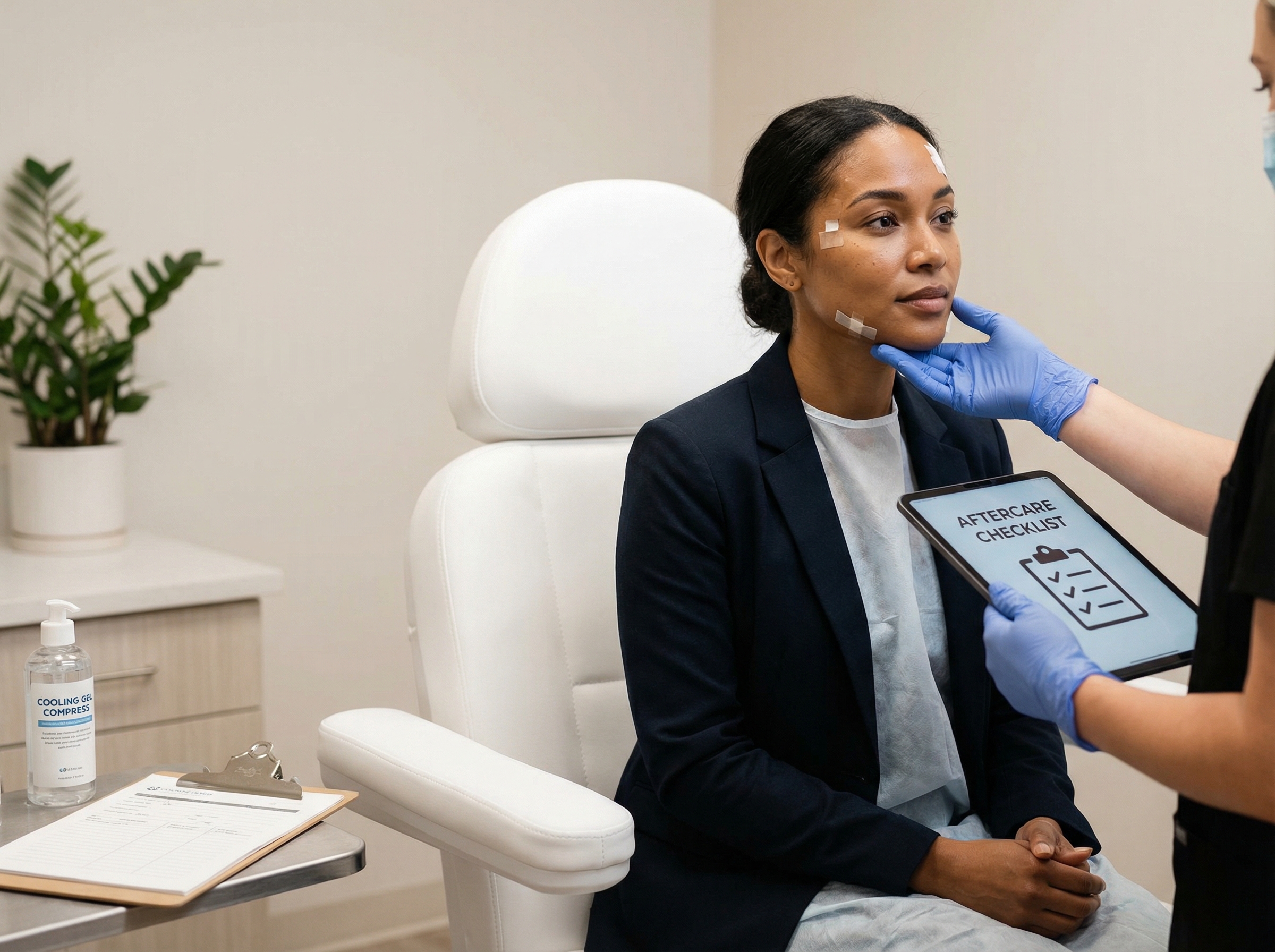
PDO thread lifts create immediate lift but depend on secure thread placement and early tissue healing. The first two weeks are critical: certain facial movements, activities, and environmental exposures can displace threads, increase swelling, or slow collagen formation. This article explains what to avoid, why it matters, practical alternatives, and how to protect your outcome alongside other non‑invasive treatments.
How PDO Thread Lifts Work and the Typical Healing Timeline
PDO threads are medical-grade sutures made from polydioxanone, a colorless, biodegradable polymer. This material has been used in cardiovascular surgery for decades because it is fully absorbable and rarely causes allergic reactions. In the context of a thread lift, these sutures are inserted into the subcutaneous layer of the skin using a cannula or needle. Once inserted, they act as a temporary scaffolding structure.
The body recognizes these threads as a foreign material—but in a beneficial way. This triggers a mild healing response that stimulates the production of new collagen, elastin, and hyaluronic acid. Over a period of about six to nine months, the PDO threads dissolve completely via hydrolysis, leaving behind a stronger, firmer mesh of your own tissue. This is why results persist even after the threads are gone.
Types of PDO Threads and What They Do
Not all threads serve the same purpose. Your provider likely selected a specific combination based on your tissue weight and skin quality.
- Smooth (Mono) Threads: These are single, smooth filaments. They do not provide a mechanical lift. Instead, they are placed in a mesh-like pattern to tighten the skin and improve texture. They are excellent for treating fine lines, crepey skin on the neck, or acne scarring.
- Screw (Twisted) Threads: These consist of one or more threads intertwined around the needle. They provide more volume than mono threads and are often used to fill deep wrinkles, such as nasolabial folds, or to define the lip border.
- Barbed (Cog) Threads: These are the “heavy lifters.” These threads have tiny, laser-cut barbs or molded cogs along their length. When inserted, these barbs hook into the soft tissue. This allows the provider to physically pull and reposition sagging skin upwards. The barbs anchor the skin in this new, lifted position while collagen forms around them.
The Dual Mechanism: Mechanical Lift and Biological Response
A PDO thread lift works through two distinct mechanisms that happen at different times.
The first is the immediate mechanical lift. This is what you see right when you look in the mirror after the procedure. The barbed threads physically support and elevate the tissue. It provides instant gratification, although the skin will look tight and possibly swollen.
The second is the biological stimulation. This is the long game. As the threads sit in the skin, they induce a process called neocollagenesis. This cellular renewal improves skin elasticity and thickness. While the mechanical lift is instant, the improvement in skin quality peaks months later.
Immediate Procedural Effects
When you leave the clinic, your face is going through a physiological adjustment. It is normal to look slightly distorted initially due to the local anesthetic fluids and the trauma of insertion.
Common immediate symptoms include:
- Edema (Swelling): This is the most common side effect. It typically peaks within the first 24 to 48 hours.
- Erythema (Redness): You may see redness at the entry points or along the track of the threads.
- Bruising: Because the face is vascular, needles can nick small blood vessels. Bruising can range from minor yellowing to deep purple spots.
- Puckering or Dimpling: This can look alarming. It happens when the skin is gathered on the thread or if a thread is placed superficially. In most cases, this resolves spontaneously as the swelling goes down and the tissue settles (usually within 7 to 14 days).
- Tightness: You will likely feel a strong pulling sensation when you open your mouth or make expressions.
Recovery from a PDO thread lift is minimal compared to surgery, but these immediate effects are part of the physiological process.
The Biological Healing Phases
Understanding what is happening under your skin helps explain why the recovery timeline looks the way it does.
Phase 1: Acute Inflammation (Days 0–3)
The body reacts to the insertion trauma and the presence of the thread. White blood cells rush to the area to prevent infection and start the repair process. This is why you experience swelling and heat. This inflammation is necessary to kickstart collagen production.
Phase 2: Proliferation and Fibroblast Activity (Weeks 1–2)
This is the critical integration window. Fibroblasts (cells that build connective tissue) begin to migrate to the threads. They start laying down a precursor to collagen. During this time, the threads are anchoring into the tissue, but the connection is not yet solidified by your own body’s structure. This is why limiting movement is vital during this phase.
Phase 3: Collagen Remodeling (Month 1–6)
The initial collagen is replaced by stronger Type I collagen. The tissue becomes firmer. Even as the PDO material begins to weaken and dissolve around month six, this new collagen matrix maintains the structural integrity.
Detailed Healing Timeline (Macro View)
While full collagen maturation takes months, the practical recovery focuses heavily on the first two weeks.
| Timeframe | What to Expect | Action Items |
|---|---|---|
| Day 1-3 | Peak swelling and bruising. Face feels tight and sore. Chewing might be uncomfortable. | Ice for 10-15 minutes every hour (first 48h). Keep head elevated. Soft/Liquid diet only. No NSAIDs. |
| Day 4-7 | Swelling subsides significantly. Bruising changes color. Tightness persists but is less sharp. | Continue avoiding strenuous exercise. Gentle skincare can resume. Monitor for asymmetry. |
| Week 2 | “Social downtime” is usually over. You look normal to others, but threads are still integrating. Sudden movements may cause sharp “zings.” | Critical Phase: Do not get complacent. Avoid wide yawning, heavy chewing, or facial massage. Light walking is permitted. |
| Month 1 | Threads are fully integrated. Any residual dimpling should be gone. Skin texture starts improving. | Return to full exercise (HIIT/Heavy Lifting) and normal diet. Follow-up appointment usually happens here or slightly earlier. |
| Month 3-6 | Peak aesthetic results. Skin looks firmer and brighter due to collagen maturation. | Maintenance skincare. Threads begin to dissolve. |
Provider Follow-Up and Monitoring
In the United States, standard clinical practice involves a follow-up appointment typically between one to two weeks post-procedure. This allows the provider to ensure the threads have not migrated and that no infection is present.
You should monitor your recovery daily. While mild asymmetry is normal due to uneven swelling, significant shifts should be reported.
Signs that require immediate medical attention:
- Infection: Fever greater than 100.4°F, heat radiating from the face, or purulent drainage (pus) from entry points.
- Extrusion: If you can see or feel the tip of a thread poking out of the skin or inside the mouth. Do not pull it.
- Persistent Puckering: If deep dimples do not improve after two weeks, your provider may need to massage or adjust the tissue manually.
- Intense Pain: Soreness is normal; sharp, intractable pain that does not respond to Acetaminophen (Tylenol) is not.
On average, patients enjoy results for 12 to 24 months, but this longevity depends heavily on how well the threads integrate during the first few weeks.
Why the Two-Week Period is Critical
The first 14 days define the success of your lift. During this window, the barbs on the threads are holding the tissue solely by mechanical friction. The body has not yet built the collagen “tunnel” that will eventually lock the threads in place.
If you engage in vigorous facial movements, heavy chewing, or sleep on your face during this phase, you risk dislodging the barbs. A dislodged barb cannot re-grip the tissue. This leads to a loss of lift, visible asymmetry, or thread migration. Protecting the threads during this acute healing phase is the single most important factor in ensuring your results last the full duration.
Why Limiting Facial Movements Matters During the First Two Weeks
The success of a PDO thread lift relies heavily on what happens immediately after you leave the clinic. While the procedure itself places the threads, your body determines how well they stay put. The first two weeks are not just about waiting for bruises to fade. This period is the biological window where the threads integrate with your tissue. Understanding the biomechanics of this process explains why keeping your face relatively still is the most effective way to protect your investment.
The Biomechanics of Thread Anchoring
To understand why movement is risky, you have to look at how the threads hold onto your skin. PDO threads, specifically the barbed or cogged varieties used for lifting, are not sutured into the bone or muscle. They float within the subcutaneous fat layer and the superficial musculoaponeurotic system (SMAS).
The threads feature microscopic barbs cut into the shaft of the suture. When a provider inserts the thread and pulls it back, these barbs open up like tiny umbrellas or fishhooks. They grab onto the soft tissue to create tension and lift the skin. This mechanical grip is the only thing holding the lift in place for the first few days.
There is no glue and no immediate scar tissue to secure them. The barbs rely entirely on friction and the physical resistance of the fat and connective tissue. If you engage the muscles underneath these threads too aggressively, you create a shearing force. The muscle contracts and pulls in one direction while the thread pulls in the other.
Tissue Integration and Micro-Fixation
The goal during the first 14 days is a process called micro-fixation. Your body treats the thread as a foreign object and immediately begins a healing response. This is beneficial because it triggers the production of collagen and fibrin. These proteins form a biological mesh that wraps around the thread and its barbs.
This mesh acts like a natural glue. Once this tissue integration occurs, the thread is no longer relying solely on the mechanical grip of the barbs. It becomes reinforced by your own tissue.
However, this biological glue takes time to set. In the first 48 to 72 hours, the connection is weakest. The fibrin is soft and easily disrupted. If you move your face vigorously, you disrupt this delicate mesh before it can harden. This delays healing and can cause the thread to slide back to its original position. This results in a loss of the lifting effect.
The Impact of Muscle Contractions
Facial muscles are incredibly strong relative to the delicate soft tissue where threads are placed. When you smile widely, chew a tough steak, or yawn, your facial muscles contract and shorten. The skin and fat above the muscle must move with it.
A PDO thread has very little elasticity. It does not stretch. When the tissue around the thread moves significantly but the thread remains static, two things can happen.
First, the tissue can rip away from the barbs. Clinicians refer to this as the thread “cutting through” the tissue. It is similar to a cheese wire slicing through soft cheese. This causes micro-tears in the subcutaneous layer. These tears lead to increased bleeding, prolonged swelling, and potential asymmetry if one side holds and the other slips.
Second, the thread itself can migrate. The force of a strong muscle contraction can dislodge the barbs from their anchor points. The thread may buckle or coil, leading to visible bumps or puckering under the skin. In severe cases, the thread can extrude or poke out from the entry or exit points.
Regional Differences and Risks
The risk of movement-related complications varies depending on where the threads are placed. Different areas of the face experience different types of tension vectors.
The Jawline and Lower Face
This area is under the highest tension. The masseter muscle, used for chewing, generates significant force. Threads placed here to define the jawline are constantly fighting against the downward pull of gravity and the movement of the jaw. Opening the mouth too wide or chewing gum transmits direct force to these threads. This is why dietary restrictions are strictly emphasized for jawline procedures.
The Midface and Cheeks
Threads in the cheeks cross over the zygomatic muscles. These muscles engage every time you smile or laugh. Because the midface is highly mobile, threads here are prone to shifting if expressions are exaggerated. A shifted thread in the cheek can result in visible asymmetry or a dimple that persists longer than the typical healing period.
Brows and Neck
The skin in the brow and neck areas is thinner. There is less subcutaneous fat to cushion the thread. In the neck, the platysma muscle is a broad sheet that moves the entire skin surface. Constant turning of the head or looking down at a phone creates repetitive strain on neck threads. In the brow, the frontalis muscle is very active. Excessive eyebrow raising can cause the threads to buckle, which is more visible due to the thinness of the forehead skin.
Factors That Increase Risk
Certain physiological factors make the tissue less capable of holding the threads securely during the integration phase. Patients with these characteristics need to be even more diligent about limiting movement.
Thin Skin and Low Body Fat
Patients with thin skin or minimal subcutaneous fat have less tissue for the barbs to grab. The margin for error is smaller. Any movement that shifts the thread is more likely to result in visible rippling or protrusion.
Prior Fillers and Scar Tissue
If you have had previous treatments, your tissue landscape is different. Scar tissue from old surgeries or trauma can be tough and resistant to the needle, making placement harder. Conversely, areas with significant filler may be softer or more fluid, providing less stable anchorage for the barbs.
Smoking and Nicotine Use
Nicotine constricts blood vessels and reduces the oxygen supply to the healing tissue. This slows down the production of collagen and fibrin. For smokers, the critical window for tissue integration may extend beyond the standard two weeks. The risk of the threads failing to anchor properly is significantly higher.
Anticoagulants and Supplements
Blood thinners, fish oil, and vitamin E increase the risk of bleeding. Micro-movements that would normally be harmless can cause hematomas (blood collections) in patients on these substances. A hematoma can put pressure on the thread and displace it from its intended path.
Inflammation and Scar Remodeling
Movement does not just mechanically shift the threads. It also provokes inflammation. While some inflammation is necessary to stimulate collagen, chronic or excessive inflammation is detrimental.
When you constantly disturb the healing tissue with vigorous movement, you keep the wound fresh. The body responds by sending more inflammatory cells to the area. This can lead to prolonged swelling and fluid retention.
Excessive inflammation can also alter the type of collagen your body produces. Instead of the smooth, structural collagen that creates a nice lift, the body may produce chaotic scar tissue. This can lead to fibrosis or encapsulation of the thread. If the thread becomes encapsulated in a thick layer of scar tissue, it cannot stimulate the surrounding skin effectively. The long-term rejuvenation effects are diminished.
Clinical Consensus on Recovery
Current aesthetic medicine standards emphasize that the outcome of a thread lift is heavily dependent on patient compliance. Recovery from a PDO thread lift is generally quick, but the internal healing takes longer than the external recovery.
Most complications, such as thread migration or extrusion, occur within the first few weeks and are often traced back to patient activity. Surgeons and practitioners agree that limiting facial animation is the single most controllable variable in preventing these issues.
The consensus is that while the threads are strong, the tissue they hold is soft. Protecting that tissue-thread interface for 14 days allows the biological fixation to take over. Once that collagen mesh is formed, the lift is secure, and you can return to normal expressions and activities without fear of compromising the results.
Exact Facial Movements and Activities to Avoid and Practical Alternatives
You now understand how those tiny barbs hold your tissue in place. The next step is keeping them there. The first two weeks are the most fragile period for a PDO thread lift. The threads have not fully integrated with the tissue yet. Your behavior during this time directly dictates whether the lift holds or slips.
Here is the exact protocol for movements and activities you must avoid.
High-Risk Facial Movements
These specific expressions and actions put the most mechanical stress on the threads.
Exaggerated Smiling and Laughing
Why it matters: Big smiles engage the zygomaticus muscles. These muscles pull upward and outward. This creates strong opposing tension against the threads anchored in your midface. This movement can snap the barbs or cause the thread to migrate.
Risk Level: High
Duration to avoid: Full 14 days (Strictly for first 72 hours)
Practical Alternative: Practice a “Mona Lisa” smile. Keep your lips closed and smile gently with your eyes. If you feel a laugh coming on, place your hands gently on your cheeks to support the tissue and limit movement.
Note: If you received Botox (neuromodulators) along with your threads, this aids recovery by temporarily freezing the muscles, preventing the strong expressions that could dislodge the threads.
Wide Yawning
Why it matters: Opening your mouth wide stretches the skin taut over the cheekbones and jawline. This is particularly risky for jawline and lower face threads. It creates a vertical pull that can dislodge anchors.
Risk Level: Medium to High
Duration to avoid: 7 to 14 days
Practical Alternative: When you feel a yawn starting, physically place your fist or palm under your chin. Apply upward pressure to prevent your jaw from opening fully. Keep the yawn contained behind closed lips.
Vigorous Lip Movements (Kissing, Smoking, Straws)
Why it matters: Pursing the lips activates the orbicularis oris muscle. This circular muscle contracts inward. It pulls on the surrounding skin where threads often terminate. Suction creates negative pressure that adds stress to the tissue.
Risk Level: Medium
Duration to avoid: First 7 days strictly, up to 14 days for straws
Practical Alternative: Drink directly from the glass or use a spoon. Avoid puckering. Save intimate kissing for after the first week.
Physical Activities and Lifestyle Restrictions
Your daily routine needs adjustment to prevent internal pressure spikes and external friction.
Chewing Hard Foods and Gum
Why it matters: The masseter muscle is one of the strongest in the body. Repetitive chewing transmits significant vibration and force through the midface and jawline. This constant motion prevents the barbs from locking into the tissue.
Risk Level: High
Duration to avoid: 7 days
Practical Alternative: Switch to a soft-chew diet. Think mashed potatoes, yogurt, soups, and protein shakes. If you eat solid food, cut it into tiny pieces to minimize chewing.
Sleeping on the Stomach or Side
Why it matters: This applies direct, asymmetrical pressure to the face. The weight of your head pressing into a pillow can flatten the lift on one side. It can also physically push the threads out of alignment before they stabilize.
Risk Level: High
Duration to avoid: Full 14 days
Practical Alternative: Sleep on your back. Use a travel neck pillow or build a fortress of pillows around your body to prevent rolling over during the night.
Strenuous Exercise and Heavy Lifting
Why it matters: High-intensity workouts increase your heart rate and blood pressure. This causes vasodilation (widening of blood vessels) and increased swelling in the face. Bouncing movements (like running) create gravitational force that tugs on the healing tissue.
Risk Level: Medium to High
Duration to avoid: 7 days for light exercise, 14 days for heavy lifting or HIIT
Practical Alternative: Stick to slow, gentle walking after day 3 to keep circulation moving. Keep your heart rate under 100 beats per minute.
Hot Environments (Sauna, Steam Room, Hot Yoga)
Why it matters: Heat causes inflammation and swelling. Excess fluid in the facial tissues puts pressure on the threads and can distort the result.
Risk Level: Medium
Duration to avoid: 14 days
Practical Alternative: Keep your environment cool. Wash your face with lukewarm water, never hot.
Medical and Aesthetic Procedures
Interfering with the skin surface or deep tissue can ruin the thread placement.
Dental Procedures
Why it matters: Dental work requires prolonged, wide mouth opening. The dentist also manipulates the cheeks and jaw. This is the number one cause of thread displacement in the lower face.
Risk Level: High
Duration to avoid: 2 weeks for routine cleaning; 4 weeks for major work (root canals, fillings).
Practical Alternative: Schedule all routine cleanings before your thread lift. If you have a dental emergency, inform your dentist immediately that you have fresh PDO threads so they can use a bite block and work gently.
Facial Massages and Aesthetic Treatments
Why it matters: Deep tissue massage, lymphatic drainage, or scrubbing can physically break the threads or detach the barbs. Treatments like microdermabrasion or chemical peels cause skin manipulation that is too aggressive for early healing.
Risk Level: High
Duration to avoid: 4 weeks
Practical Alternative: You can gently wash your face, but do not rub. Apply skincare with a feather-light touch.
Practical Aftercare Protocols
Managing your recovery proactively helps the results settle evenly.
Sleep Position Strategy
Sleep with your head elevated at a 30-degree angle for the first 3 to 5 nights. This uses gravity to drain fluid away from the face and reduces morning swelling. Use a wedge pillow or stack two firm pillows. Poor sleep increases cortisol, which can break down collagen, so prioritize 7–9 hours of quality rest.
Cold Compress Protocol
Ice is your best friend for the first 48 hours. Apply a cold compress for 10 to 15 minutes every hour while awake.
Important: Do not put ice directly on the skin. Wrap it in a thin cloth. Do not press hard. Just rest it gently against the areas of insertion.
Hygiene and Showering
You can shower 24 hours after the procedure. Keep the water lukewarm. Do not let the shower stream hit your face directly. Wash your hair gently with your head tilted back to avoid water pressure on the face. When washing your face, use a gentle cleanser and pat dry. Do not rub or drag a towel across the skin.
Skincare and Makeup
Wait 24 to 48 hours before applying makeup. When you do resume, use clean brushes and apply products with a dabbing motion rather than sweeping strokes. You can resume your basic skincare routine after 48 hours, but avoid active ingredients like retinols or exfoliants for 7 days.
Timeline for Other Modalities
- Botox/Dysport: Safe to resume after 14 days (or can be done simultaneously with threads).
- Dermal Fillers: Wait 2 to 4 weeks to ensure swelling has subsided and anatomy is clear.
- Lasers/IPL: Wait 4 weeks to avoid heat accumulation in the thread area, which could weaken the PDO material.
Troubleshooting Checklist
Most recovery is smooth, but you need to know when to act.
Normal Symptoms (No need to call):
- Mild asymmetry (usually due to uneven swelling).
- Tight sensation or “pulling” feeling.
- Small dimples or puckering at entry points (resolves in 3-7 days).
- Bruising that turns yellow/green.
- Sharp “zingers” or quick twinges of pain when moving.
Warning Signs (Call the clinic):
- Increasing Asymmetry: If one side looks significantly lower or different after swelling goes down.
- Persistent Severe Pain: Pain that is not relieved by Tylenol and lasts more than 48 hours.
- Thread Extrusion: You can see or feel the tip of the thread poking out of the skin. Do not pull it.
- Heat and Redness: The skin feels hot to the touch and redness is spreading.
Urgent Care Signs (Seek immediate help):
- Fever over 100.4°F (38°C).
- Purulent drainage (pus) from entry points.
- Severe swelling that impacts vision or breathing.
Patient-Friendly Dos and Don’ts
DO:
- Sleep on your back with head elevated.
- Take Acetaminophen (Tylenol) for pain.
- Keep your face clean and dry.
- Eat soft foods like yogurt, eggs, and smoothies.
- Move your face as little as possible.
- Hydrate well to support collagen synthesis.
DON’T:
- Take NSAIDs (Advil, Ibuprofen, Aspirin) for the first 48 hours (increases bruising).
- Drink alcohol for 3 days (dehydrates skin and increases swelling).
- Open your mouth wide for apples or burgers.
- Touch, pick, or massage the entry points.
- Apply heavy pressure to your cheeks.
Two-Week Day-by-Day Micro Timeline & Action Plan
This schedule minimizes the risk of thread displacement and maximizes the collagen production that gives you long-term results.
| Day 1 | Strict Rest. Keep head elevated. Ice for 15 mins every hour. Liquid diet only. No touching the face. Do not bend over to pick things up. |
| Day 2 | Continue Icing. Swelling may peak today. Stay on soft foods. You can gently wash your face with water (pat dry only). Avoid NSAIDs. |
| Day 3 | Gentle Movement. You can stop constant icing. Resume light skincare (no rubbing). Bruising may appear. You can take slow, gentle walks to aid circulation. |
| Day 4 | Stabilization. Soreness should decrease. You can return to sedentary work. Continue back sleeping. |
| Day 5-6 | Observation. Dimpling should start to relax. You can introduce slightly more texture to food (pasta, soft fish). |
| Day 7 | Milestone. You can resume light exercise (light weights, low impact). Makeup is fully safe. Check for asymmetry. Avoid active skincare ingredients (retinols) until now. |
| Day 8-10 | Integration. Threads are settling. You can smile more naturally but avoid extremes. Stop sleeping elevated if swelling is gone. |
| Day 11-13 | Easing Restrictions. You can return to side sleeping if careful. Resume normal skincare actives. |
| Day 14 | Clearance. Resume normal exercise (HIIT, heavy lifting). Resume normal diet (chewy foods okay). Book follow-up if needed. |
Long-Term Maintenance and Lifestyle
Your behavior outside of the specific restrictions also impacts your results. Collagen production is a biological process that requires energy and nutrients.
Hydration and Nutrition
Your body needs water and protein to build new collagen. Drink at least eight glasses of water a day. Include Vitamin C in your diet, as it is essential for collagen synthesis.
Sun Protection
UV radiation breaks down collagen. Even if you are indoors, UV rays penetrate windows. Wear a broad-spectrum SPF 50 every day. This protects the new collagen your body is producing around the threads.
Communication with Your Clinician
Open communication with your provider ensures safety. Do not hesitate to reach out if something feels wrong. It is better to ask a question than to ignore a potential complication. A 2019 study in the Aesthetic Surgery Journal highlighted that complications often arise from technical issues or poor aftercare compliance. You invested time and money into this procedure. Protect that investment by following this daily guide.
Summary
A PDO thread lift offers significant rejuvenation without surgery, but it is not a “set it and forget it” procedure. The two weeks following your appointment are just as important as the skill of your injector. By strictly avoiding specific facial movements, sleeping correctly, and managing your diet, you allow the threads to anchor securely. This patience pays off in the form of a lifted, youthful contour and robust collagen production that can last for 12 to 24 months.
Sources
- How Does a PDO Thread Lift Work? – ProMD Health — On average, patients enjoy results for two to three years before another treatment is needed. Compare that to dermal fillers, which last an …
- PDO Thread Lift Procedure, Benefits, and Side Effects – Healthline — Recovery from a PDO thread lift is minimal. You may have some swelling and bruising for the first 24 to 48 hours but you can return to most of …
- What To Expect During PDO Thread Lift Recovery – Beauty Cult — Recovery from a PDO thread lift is generally quick and straightforward, especially compared to surgery. Most people feel back to normal within a week.
- PDO Thread Lift Explained: Key Facts You Must Know — Many clients return to normal routine within 24–48 hours. Avoid strenuous workouts and major dental appointments for a week so threads can settle. Risk Profile.
- PDO Threads | Face & Body | Chicago, IL – Allure Wellness — PDO thread lift patients generally experience full healing from minimal side effects (mainly swelling and bruising) in as little as two days or up to one week.
- How Long Does a PDO Thread Lift Last? — PDO thread lifts typically last 1-3 years. Results can be maintained through regular touch-ups. Often called “lunchtime lifts,” PDO thread lifts take less than …
- Thread Lift | Midsota Plastic Surgery – CentraCare — Treatment Time (Estimated): 40-60 minutes; Recovery Time (Estimated): 1-2 days; Cost: Contact us for a quote. What are the benefits of thread lift? Subtly …
- What you need to know about thread lifts | ASPS — Patients sometimes experience mild soreness and swelling for a few days after having this procedure, but it can usually be managed with over the …
- Effectiveness, Longevity, and Complications of Facelift by Barbed … — A more accurate complication rate would therefore be 17.4%, which is still high but was possibly related to technical issues during the …
Legal Disclaimers & Brand Notices
The content provided in this article is for informational purposes only and does not constitute professional medical advice, diagnosis, or treatment. Always seek the advice of a physician or other qualified health provider with any questions you may have regarding a medical condition or specific aesthetic procedure. Never disregard professional medical advice or delay in seeking it because of something you have read in this article.
All product names, logos, and brands mentioned in this text are the property of their respective owners. Use of these names, trademarks, and brands does not imply affiliation with or endorsement by them. Specifically:
- Botox® is a registered trademark of Allergan, Inc.
- Dysport® is a registered trademark of Ipsen Biopharm Limited.