Filler migration happens when injectable material shifts from its intended placement, causing asymmetry, lumps, or a blurred lip border. This practical guide explains how to recognize migration, why it happens, immediate steps to take, and treatment options for hyaluronic acid and nonresorbable fillers. You’ll also find prevention tips, realistic recovery expectations, and when to contact a qualified provider.
Understanding filler migration
Filler migration occurs when the injectable gel shifts from the precise target zone into surrounding tissue. Clinicians refer to this as displacement. Patients often describe it as a loss of crispness in the lip border or the appearance of a “shelf” above the upper lip. This movement distorts the intended shape and creates an unnatural fullness that contradicts the goal of aesthetic enhancement. Understanding the mechanics behind this issue helps in distinguishing between a botched procedure and natural product behavior.
Defining Migration and Safety Implications
True migration involves the physical movement of the product across anatomical boundaries. This differs from poor placement where the injector simply puts the filler in the wrong spot to begin with. Migration matters for more than just looks; displaced filler can obstruct lymphatic drainage, leading to chronic puffiness or intermittent swelling long after the initial treatment. It creates a cycle where the tissue remains inflamed because the product is pressing on structures it should not touch.
Safety concerns also arise when patients mistake migration for more serious complications. It is vital to differentiate migration from vascular occlusion. Vascular occlusion is a medical emergency where filler blocks a blood vessel, causing immediate pain and skin blanching. Migration is a slow process that does not cause tissue death. Infection is another distinct complication characterized by heat, redness, and acute pain. In contrast, migration is typically painless and presents as a firm distortion rather than an acute injury.
Settling Versus Moving
Patients frequently confuse early settling with migration. The first four weeks after injection involve significant tissue changes. Hyaluronic acid is hydrophilic, meaning it attracts water. This causes swelling that can mimic displacement. The gel also needs time to integrate with the lip tissue, a period called settling. The product softens and meshes with the mucosal layers during this phase. True migration usually presents later, becoming evident months or even years after the procedure. If the lip looks uneven in week two, it is likely residual swelling or settling. If a ridge appears above the vermilion border in month six, that is migration.
Product Properties and Selection
The type of filler used plays a massive role in stability. Hyaluronic acid (HA) remains the gold standard for lips in 2025 due to its reversibility and safety profile. Other materials exist but carry different risks and handling requirements.
* Hyaluronic Acid (HA): The most common choice. It is soft and reversible. Brands vary by crosslinking technology which dictates how firm or fluid the gel feels.
* Calcium Hydroxylapatite (CaHA): This is generally too thick for the body of the lip. It carries a higher risk of nodule formation in high-mobility areas.
* Poly-L-lactic Acid (PLLA): This is a biostimulator. It is not indicated for the lips because it causes collagen production that can lead to irregular lumps in dynamic muscle tissue.
* PMMA (Polymethylmethacrylate): This is a permanent filler consisting of microspheres that the body cannot break down. The risk of permanent complications and migration is significantly higher.
Rheology refers to the physics of the gel. Two key factors influence movement: G-prime and cohesivity. G-prime measures the lift or hardness of the gel, while cohesivity measures how well the gel sticks together. The lips move constantly. A filler with high G-prime but low cohesivity might fracture or spread when the muscle contracts. A product with high cohesivity stretches with the smile and snaps back, resisting migration better. Injectors must select a product with the right balance of viscosity and elasticity to withstand the mechanical stress of the mouth.
Anatomy and Biomechanics
The lips function as a sphincter. The orbicularis oris muscle encircles the mouth and contracts like a camera aperture. This constant squeezing action creates significant pressure on any implant or filler. The anatomy includes specific planes of tissue: the skin, the superficial fat, the muscle, and the wet mucosa. Injecting into the correct plane is critical. Filler migration is best understood as the process of dermal fillers moving into the superficial fat pads or the cutaneous lip rather than staying in the deeper muscle or submucosal layer.
Ligaments also play a role. The lips have limited ligament support compared to the cheeks, with fewer fibrous septae to hold the product in place. If an injector overfills the area, the pressure inside the lip exceeds the tissue’s ability to contain it. The path of least resistance is often upward into the cutaneous upper lip, resulting in the infamous “filler mustache.”
Prevalence and Reporting
Data on migration frequency varies. Clinical trials often underreport it because they follow patients for a limited time. However, MRI and ultrasound studies have revealed that filler persists longer than the 6 to 12 months stated on the box and can remain in the tissue for years. Migration is not an epidemic, but it is more common than previously thought. The lip fillers market is valued at $1.43 billion in 2025, and with this volume of treatments, the absolute number of migration cases has risen. However, the percentage relative to total treatments remains low when performed by experienced providers. Most cases are mild and go unnoticed by the patient until pointed out by a professional.
Recognizing signs your lip filler has moved
You might be looking in the mirror right now and wondering if your results have shifted. It is a stressful feeling. You need to know exactly what to look for so you can distinguish between normal healing and actual product displacement. We break this down into a prioritized checklist of signs, ranging from visual cues you can see to tactile changes you can feel.
The Clinical Checklist: What to Look For
Migration does not always look the same for everyone; it depends on where the filler was placed and how your specific anatomy reacts. We categorize these signs into immediate issues and delayed changes.
Immediate Signs (First 72 Hours)
True migration is rare immediately after injection. What you see in the first few days is usually product displacement from the pressure of the injection or acute swelling. However, you should monitor these indicators:
* New Asymmetry: One side of the lip looks significantly higher or fuller than the other, which was not present before your appointment.
* Visible Displacement: You can see a distinct lump or bump that distorts the natural shape of the lip.
* Uneven Fullness: The volume does not look consistent. It might look heavy in the center or bulging at the corners.
Delayed Signs (Weeks to Months Later)
This is where true migration usually presents. The filler has integrated with the tissue but has moved from the vermilion body (the pink part) into the cutaneous lip (the skin above) or the mucosa (wet-dry border).
* The “Filler Mustache”: This is the most common visual sign. You see a shadow or a shelf above the top lip. It looks like a ridge of volume that sits on the skin rather than in the lip itself.
* Blurred Vermilion Border: The crisp edge between your lip and your skin becomes fuzzy. The definition is lost, and lipstick might bleed upwards into fine lines that were not there before.
* Palpable Lumps: You can feel firm nodules or bumps when you run your tongue over the inside of your lip or press with your fingers. These lumps are often located outside the area that was treated.
* Beads Along the Border: You might feel or see small, pearl-like bumps lining the edge of the lip. This often happens if the filler was placed too superficially.
* Change in Smile Dynamics: Your smile looks different. The upper lip might not tuck under naturally, or it might feel stiff or heavy when you talk or laugh.
* Persistent Firmness: The lips should feel soft once healed. If an area remains hard or rubbery after four weeks, the product may be overly concentrated in one spot.
Timeline: When Does Migration Show Up?
Understanding the timeline helps you manage your anxiety. Migration is rarely an overnight event; it is a slow process.
Hours to Days: Changes here are almost always related to the procedure itself. The trauma of the needle causes inflammation, and the hydrophilic filler pulls in water. This creates immediate volume that can look like migration but is usually just temporary fluid retention.
Weeks to Months: This is the window for actual migration. Muscle movement from talking and eating slowly pushes the product. If the filler was placed in a plane of tissue that offers little resistance, it will move to the path of least resistance. You might notice these changes three months or even a year after your treatment.
Distinguishing Migration from Routine Healing
The first six weeks are deceptive. You cannot judge the final position of the filler until the tissue has fully settled. Patients often panic in week two because their lips look “ducky” or projected. This is normal.
Swelling vs. Migration: Swelling is diffuse, feels tight and tender, and often fluctuates throughout the day (usually worse in the morning). Migration is focal; it is a specific lump or ridge that does not change with the time of day and is generally painless.
Bruising vs. Displacement: Deep bruising can create firm lumps called hematomas. These can feel exactly like a ball of filler. A bruise will change color and fade over two weeks, whereas a migrated bolus of filler will stay the same size and shape.
The 4-Week Rule: Do not make any decisions about dissolving or correcting until at least four weeks have passed. Six weeks is even better. Most “migration” scares resolve on their own as the product integrates and the water absorption stabilizes.
Red Flags: When to Seek Urgent Care
There is a major difference between cosmetic migration and a medical emergency. Migration is an aesthetic issue; it is annoying but not dangerous. Vascular occlusion is a blockage of blood flow that requires immediate attention to prevent tissue death.
If you experience any of the following, do not wait. Call your injector or go to the ER immediately.
* Sudden Severe Pain: Injections hurt, but the pain should stop when the needle is removed. Throbbing, escalating pain hours after the procedure is not normal.
* Blanching: The skin turns white or pale and does not return to pink when you press on it. This indicates blood flow is blocked.
* Livedo Reticularis: This looks like a fishnet pattern of red or purple discoloration on the skin. It can appear on the lip, the nose, or the forehead and is a sign of vascular compromise.
* Vision Changes: Any blurriness, double vision, or pain behind the eye is a critical emergency.
These symptoms indicate that the filler has entered or compressed a blood vessel. This is not migration; it is an occlusion.
Documenting Your Changes
Memory is unreliable. You look at your face every day, so gradual changes are hard to spot. You need objective data to show your provider.
Start a photo log. Take a clear photo of your lips in good lighting once a week for the first month. Keep the angle and lighting consistent, do not use filters, and take one photo with a relaxed face and one smiling.
Write down notes alongside the photos. Record the date and your activity level. Did you exercise heavily? Did you have a dental appointment? Did you fly on a plane? These activities can increase swelling temporarily. If you notice a change, check your notes. If the “migration” appeared after a salty meal and a long flight, it is likely just water retention. If the ridge persists for two weeks with no change, it is likely migration.
You can read more about expert opinions on these signs in this article on filler migration concerns. Having this documentation ready for your follow-up appointment allows your injector to make an accurate diagnosis.
Why migration happens and how to prevent it
Understanding why filler moves is the only way to stop it from happening. Migration is rarely random; it is almost always a matter of physics and anatomy. When you introduce a gel into a dynamic, moving muscle like the lip, that gel needs space to settle. If there is no space, or if the retaining walls of the lip are weak, the product will follow the path of least resistance. Usually, that path leads upward into the cutaneous upper lip, creating that unwanted shelf or shadow.
The Mechanics of Movement
The primary cause of migration is often volume overload. The lip has a limited capacity to hold filler within the vermilion border. Once that anatomical pocket is full, any additional product pushes past the natural boundaries. This is why “building” lips over several sessions is safer than injecting a large amount at once.
Technique plays a massive role here. Injections placed too superficially can bead up or slide under the thin skin of the mucosa. Conversely, placing filler in the wrong plane where muscle activity is highest guarantees displacement. The orbicularis oris is the muscle surrounding the mouth. It acts like a sphincter, constantly contracting when you speak, eat, or smile. If a bolus of filler sits directly in the path of this muscle contraction, the constant squeezing motion will milk the product out of place over time.
Product selection is just as critical. We look at two main properties in fillers: G-prime and cohesivity. G-prime refers to how hard or stiff the gel is, while cohesivity is how well it sticks together. Lips generally require a product with moderate G-prime and high flexibility. If an injector uses a stiff, high G-prime filler meant for cheekbones in the lips, it will not integrate. It remains as a distinct lump that can easily be pushed around. Newer filler technologies in 2025 focus heavily on this tissue integration to minimize risk, but using the wrong product for the area remains a common error.
Patient Anatomy and Risk Factors
Not every patient is a candidate for large volume augmentation. Those with naturally thin soft tissues or a very tight vermilion border are at higher risk for migration because there is simply less room for the gel to expand. If you have had prior lip surgeries or have scar tissue from old injuries, the filler may flow unpredictably around those internal barriers.
Inflammatory conditions also matter. Chronic inflammation can weaken tissue integrity, making it easier for the product to seep into surrounding areas. Even the natural aging process weakens the structural support of the lip border, making it less capable of holding the filler in place.
The Human Element: Post-Procedure Actions
What happens after you leave the clinic is equally responsible for the final result. High-pressure environments inside the lip tissue can force the product out. This pressure often comes from aggressive massage. Unless specifically instructed by your provider to smooth a lump, massaging the area in the first few days can physically push the gel into the white roll of the lip.
Other physical triggers include early dental work. Having your mouth stretched open for a cleaning or procedure within two weeks of injection puts immense strain on the settling product. Vigorous exercise increases blood pressure and heart rate, which can increase swelling and potential displacement in the first 48 hours. Even playing wind instruments or using straws creates suction and muscle tension that can distort the filler before it integrates.
Prevention Strategies for the Injector
Preventing migration starts with a conservative approach. A staged treatment plan is always superior to attempting full correction in one visit. Injectors should prioritize these technical safeguards:
* Respect the Anatomy: Stop injecting before the tissue reaches maximum capacity. It is better to under-fill and touch up later.
* Layering Techniques: Placing product at the correct depth, often deep to the muscle or in the proper submucosal plane, anchors the filler better than superficial placement.
* Cannula Usage: Using a blunt-tipped cannula can sometimes reduce trauma and allow for smoother placement in the correct plane compared to multiple needle punctures.
* Slow Injection Speed: High-pressure injection forces filler into areas it shouldn’t go. Low-pressure, slow delivery allows the tissue to accommodate the volume.
Prevention Strategies for the Patient
Your behavior during the recovery window directly impacts retention and placement. Preventing migration requires strict adherence to aftercare protocols. You need to treat the treated area like a healing wound, even if the skin is unbroken.
Patient Prevention Checklist (First 48-72 Hours):
* Avoid all pressure on the lips. This includes sleeping on your face or resting your chin in your hands.
* Do not massage the area. If you feel a lump, wait for your follow-up appointment unless told otherwise.
* Skip the gym. Heavy lifting and cardio increase intracranial pressure and swelling.
* Avoid extreme heat. Saunas, steam rooms, and hot yoga can exacerbate swelling and fluid retention.
* No straws or smoking. The pursing motion engages the muscle that displaces filler.
* Kissing Caution: Light contact is generally safe after the anesthesia wears off, but heavy pressure or suction can physically displace the malleable gel before it stabilizes.
Patient Prevention Checklist (First 2 Weeks):
* Schedule a follow-up. A 2-week check is vital to catch early migration while it is easier to manage.
* Delay dental cleanings. Wait until the product has fully integrated.
* Avoid facials or face-down massages. The pressure from the headrest or the esthetician’s hands can shift the product.
By understanding that filler is a gel subject to physical forces, both patients and providers can adjust their behaviors to keep the product exactly where it belongs.
What to do if you suspect migration
Suspecting that your lip filler has moved can be stressful. You might notice a shelf above the lip border or a lump that feels out of place. The most important thing is to act calmly and logically. Panic often leads to poor decisions like aggressive home massage, which usually makes the problem worse.
Immediate Steps for Patients
Your actions in the first few hours after noticing a change matter. Do not try to fix this yourself. Follow these specific instructions while you wait for your appointment.
1. Stop touching the area. Patients often try to mold or flatten the migrated filler. This pressure can push the gel further into the cutaneous lip or up toward the nose. Keep your hands away.
2. Document the change. Take clear photos in natural lighting. Take one from the front and one from the profile view. This helps your provider see the progression when you arrive at the clinic.
3. Avoid heat. Do not use hot compresses. Heat increases blood flow and swelling. This makes it difficult to distinguish between fluid retention and actual product displacement.
4. Contact your injector. Call the clinic where you were treated. If you do not trust their technique or if they dismissed your concerns previously, seek a second opinion from a board-certified dermatologist or plastic surgeon who specializes in complications.
Clinical Evaluation and Ultrasound
When you arrive for your assessment, the provider will review your history. They need to know exactly when the filler was placed and what specific brand was used. Different products have different weights and cohesivity levels, which impacts how they move and how they must be treated.
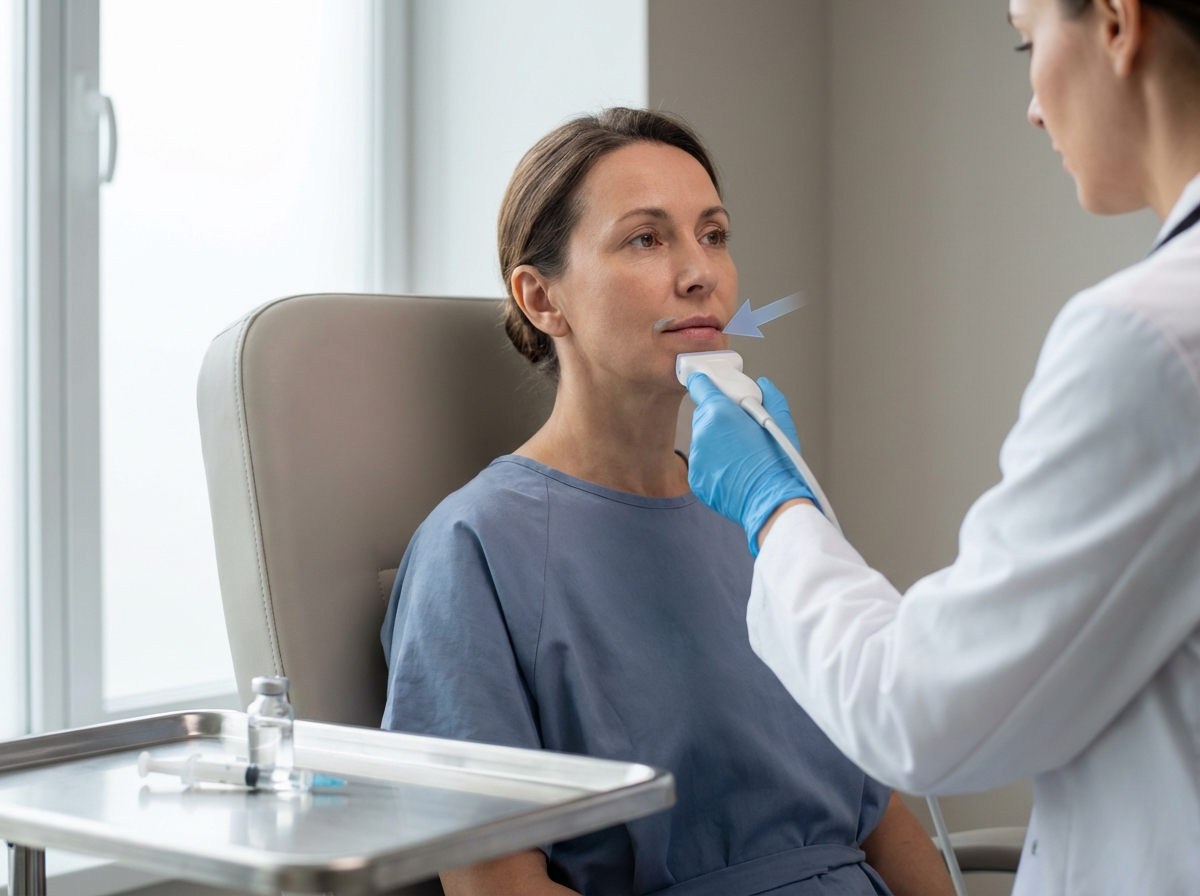
Physical palpation is the traditional method of checking filler. The provider feels the tissue for firmness or nodules. However, feeling the lip is often not enough. By 2025, Point-of-Care Ultrasound (POCUS) has become the gold standard for diagnosing migration. An ultrasound scan allows the clinician to see under the skin and identify exactly where the filler deposits are located—whether in the muscle, the fat pads, or the mucosal layer. This imaging confirms if the issue is truly migration or just swelling.
Treating Hyaluronic Acid (HA) Migration
Most lip fillers are made of Hyaluronic Acid. This is fortunate because HA is reversible. The primary treatment is the injection of hyaluronidase, an enzyme that breaks down the hyaluronic acid chains, allowing the body to absorb the fluid.
The process requires precision. Simply flooding the lip with enzyme is outdated. Providers now use ultrasound-guided dissolution. This technique allows the injector to place the enzyme directly into the pocket of migrated filler, targeting the problem area while sparing your natural hyaluronic acid.
Key considerations for hyaluronidase treatment:
* Allergy testing. Hyaluronidase is an enzyme. Some patients may have an allergic reaction to it. A patch test on the arm is standard protocol before injecting the face.
* Dosing varies. There is no standard dose. Older or highly cross-linked fillers require more enzyme and multiple sessions. You might not see full resolution after one visit.
* Discomfort and swelling. The injection stings more than the filler itself. You will likely experience significant swelling immediately after the procedure.
* Visual Aftermath (The “Prune” Look): Your lips might look wrinkled or deflated initially. Hyaluronidase removes the synthetic filler and can temporarily break down some of your natural hyaluronic acid. This is not permanent; your body regenerates its own HA quickly. The skin on the lips is resilient and typically retracts well. Hydration is key during this period.
Managing Non-HA Filler Migration
Treatment is more complex if your lips were treated with Calcium Hydroxylapatite (CaHA), Poly-L-Lactic Acid (PLLA), or permanent substances like silicone or PMMA. These products cannot be dissolved with an enzyme.
Treatment options include:
* Steroid injections. Intralesional corticosteroids can help reduce inflammation and shrink nodules. This is often the first line of defense for inflammatory lumps.
* 5-Fluorouracil (5-FU). This medication is sometimes mixed with steroids to treat tough granulomas or scar tissue formation without causing skin atrophy.
* Surgical excision. If the material is permanent and visually unacceptable, surgery is the only way to remove it. A surgeon must cut out the pocket of filler. This carries a risk of scarring and deformity.
Permanent fillers carry higher risks. Silicone migration is particularly difficult to manage because the silicone can integrate into the tissue, leading to chronic inflammation that requires long-term management.
Recovery and Timelines
Understanding the timeline helps manage anxiety. If you receive hyaluronidase, the enzyme works within minutes to hours. However, the results are often masked by swelling. You might look puffy for 24 to 48 hours. Once the swelling subsides, the lip will look deflated. This is temporary.
Do not rush to refill the lips. The tissue needs to recover. Most experts recommend waiting at least two weeks after dissolving before attempting any new filler injections. This ensures all inflammation has resolved and the baseline anatomy is clear.
Professional Treatment Timeline (2025 Standard):
| Day 0: Assessment | Your provider examines the tissue. In modern practice, this often involves ultrasound mapping to locate the exact depth and spread of the migrated filler. |
| Day 1: Dissolving | Injection of hyaluronidase. This enzyme breaks down the hyaluronic acid. It works immediately, but swelling will occur. You might look “deflated” or wrinkled initially as the volume disappears. |
| Day 3-7: Recovery | Swelling from the hyaluronidase subsides. The lips return to their baseline size. Some patients require a second round of dissolving if the migration was extensive or if a cross-linked filler was used. |
| Week 2: Re-evaluation | The provider checks the tissue. The lips must be completely free of old filler and inflammation before adding new product. |
| Week 4+: Refilling | If the tissue is healthy, you can reinject. This time, the approach should be slower, using less volume and potentially a different technique to prevent recurrence. |
Safety Warnings
Never attempt to buy hyaluronidase online or use home remedies to dissolve filler. These products are unregulated and dangerous. You risk infection and permanent tissue damage.
You must also distinguish between migration and vascular occlusion. As noted in the “Red Flags” section, if your lip turns white, dusky, or purple and you feel severe pain, this is not migration—it is a medical emergency requiring immediate professional care to save the tissue.
Frequently Asked Questions
Patients often have specific worries when they notice their lip shape changing. These answers cover specific concerns regarding lifestyle factors and future treatments.
Can I cause migration by massaging or kissing
You play a role in how the product settles. Massaging the area without a direct instruction from your provider is a primary cause of early migration. Patients often feel a lump and try to smooth it out themselves. This pressure forces the gel out of the intended compartment and into the surrounding tissue. You must leave the area alone to allow the filler to integrate with your tissue.
Kissing requires caution in the first 48 hours. Light contact is generally safe after the anesthesia wears off. Heavy pressure or suction can physically displace the malleable gel before it stabilizes. Avoid sleeping on your face for the first few nights for the same reason. Sustained pressure distorts the shape while the product is still integrating.
Will my lips look worse after dissolving?
The process is efficient but it can be visually shocking. Your lips might look wrinkled or deflated initially. Hyaluronidase removes the synthetic filler and can temporarily break down some of your natural hyaluronic acid. This is not permanent. Your body regenerates its own HA quickly. The skin on the lips is resilient and typically retracts well. Hydration is key during this period. The “prune” look usually resolves within a week as your natural hydration levels restore.
Will migration affect future treatments
You cannot simply add more filler to camouflage migration. Adding volume to a distorted shape only worsens the projection and heaviness. You must dissolve the old product and start with a clean slate.
Tissue needs time to heal after dissolving. Most providers recommend waiting at least two weeks before reinjecting. This allows the inflammation to subside and the skin to retract. In cases of severe or long-standing migration, you might need to wait longer to ensure the lip tissue has regained its natural tone. Future treatments should involve smaller amounts of stiffer product placed deeply to avoid repeating the issue.
Final takeaways and next steps
We have covered the mechanics of migration, the science behind why fillers shift, and the specific questions most patients ask. Now we need to consolidate this into a practical strategy. Understanding the risks is useful, but knowing exactly how to navigate the next steps is vital for your safety and aesthetic outcome.
Prevention Priorities
The most effective way to handle migration is to stop it before it starts. While you cannot control how your body metabolizes hyaluronic acid, you can control the mechanical factors that contribute to displacement. The lip filler market is massive, valued at over $1.43 billion in 2025, which means there are thousands of providers to choose from. This saturation makes your selection process even more critical.
Stick to these four pillars of prevention:
* Vet your injector. Do not choose based on price or Instagram trends. Look for board-certified dermatologists, plastic surgeons, or highly experienced nurse injectors who understand facial anatomy and the specific rheology of different filler brands.
* Start conservative. Overfilling is the primary cause of migration. The lip has a limited capacity to hold volume. Exceeding that “pocket” forces the gel to move into the cutaneous lip or the mucosa.
* Select the right product. Not all fillers work for lips. Stiff, high G-prime fillers are more likely to migrate if placed in high-movement areas like the vermilion border. Your provider should explain why they are choosing a specific product.
* Respect the aftercare. The first 48 hours are crucial. Avoid pressure, intense heat, and strenuous exercise. These early actions allow the gel to integrate with your tissue rather than shifting under pressure.
Documentation and Referrals
Keep a personal record of your treatments. Ask your injector for the specific name of the filler used (e.g., Juvéderm Volbella, Restylane Kysse) and the volume injected. Save this in a note on your phone. If you move to a new city or switch providers, this information is invaluable.
There are times when you should seek a second opinion. If your injector dismisses your concerns, refuses to acknowledge obvious migration, or suggests adding more filler to “camouflage” the migration, it is time to leave. Camouflaging migration usually leads to a heavier, more distorted look. You need a specialist who is comfortable with ultrasound and hyaluronidase to correct the anatomy first.
Safe aesthetic outcomes rely on open communication. You must feel comfortable telling your provider that you are unhappy with the placement. A good injector will want to fix the issue rather than ignore it. By staying informed and reacting quickly to signs of displacement, you protect your appearance and ensure your results remain natural and balanced.
Sources
* Lip Filler Injections: Market Trends, Brands, and the Future in 2025 — Global Market Size: The lip fillers market is valued at $1.43 billion in 2025 and expected to reach $1.69 billion by 2029.
* Filler Migration: Should You Be Worried? Experts Weigh In – Aedit.com — “Filler migration is not a common side effect of dermal filler injection procedures,” NYC-based board-certified dermatologist Brendan Camp …
* Filler Migration: Prevent It with The Skin Company (2025) — Yes, dermal filler can migrate, especially in high-movement areas like lips. This occurs when filler shifts from its injection site due to poor technique, …
* The Future of Filler Migration | American Med Spa Association — Filler migration is best understood as the process of dermal fillers moving to areas other than their initial, intended injection sites.
* Lip Filler Migration Causes and Risks Explained – GoodRx — Lip filler migration occurs when the injectable spreads away from the injection site. Learn what causes lip filler to migrate, how to reduce …
* Lip Filler Versus “Lip Flip”: Longitudinal Public Interest and a … – NIH — The lip augmentation market is projected to reach a value of 11.6 billion USD by 2030. Hyaluronic acid (HA) fillers are the most common type due …
* [PDF] FDA Executive Summary General Issues Panel Meeting on Dermal … — In 2024, dermal filler procedures experienced continued growth, maintaining their position as the second most popular minimally invasive …
* Understanding Filler Migration and Retention: The Science Explained — Increased Surgical Complexity The statistics here are telling: 51.9% of surgeons believe fillers increase facelift difficulty; 82% of patients …
* Your Guide to Silicone Lip Filler in 2025 – Renee Burke, MD — Despite their popularity for lip augmentation, these fillers carry risks like chronic inflammation, silicone migration, and the formation of …