Botox can rarely cause a droopy eyelid (ptosis), a side effect that worries patients and providers alike. This guide explains why ptosis happens after neurotoxin injections, the biological progression of the condition, immediate at-home care, medical treatments (including topical options approved in the U.S.), and prevention strategies to minimize risk and speed recovery.
How Botox Causes Droopy Eyelid and the Biological Timeline
The moment you realize your eyelid is sitting lower than usual after a cosmetic injection can be unsettling. This side effect typically does not appear immediately after the needle leaves your skin. Instead, it follows a specific biological progression that mirrors how the toxin interacts with your nervous system. Understanding this timeline helps manage expectations and reduces the anxiety that often accompanies a change in appearance.
The Initial Onset and Progression
Most patients notice the first signs of a droopy eyelid between two and ten days after their appointment. While some rare cases report changes within 48 hours, the toxin usually needs time to diffuse from the injection site and bind to the nerve endings. By day ten to fourteen, the effect is typically fully established. This window is when the botulinum toxin reaches its maximum interference with the signals sent to the levator palpebrae superioris, the primary muscle responsible for lifting your eyelid.
If you reach the fourteen-day mark without any changes in your eyelid position, you are likely in the clear. The severity of the droop is often tied to the amount of toxin that reached the muscle. A small amount might cause a heavy feeling or a subtle 1-millimeter dip, while a larger dose can lead to a more significant closure of the eye. It is rare for the condition to worsen after this two-week mark; if you notice the eyelid sinking further after the second week, you should seek a medical evaluation to rule out other neurological causes.
Biological Mechanisms of Recovery
Recovery from Botox-induced ptosis is not about the toxin wearing off in the traditional sense. It is a matter of your body restoring communication between the nerves and the muscles. Botulinum toxin works by cleaving proteins required for the release of acetylcholine, the chemical messenger that tells your muscles to contract. Once the toxin has bound to the nerve endings, the muscle remains relaxed until the body can restore communication.
To fix this, your body must undergo a process called nerve terminal sprouting. Your nerves actually grow new temporary branches to bypass the blocked sites and reestablish a connection with the muscle fibers. Eventually, the original synaptic connections also recover as the toxin is naturally metabolized and cleared by your system. This biological “rewiring” is why recovery happens in weeks rather than days. It is a slow, steady physiological repair that cannot be rushed by massage or heat. In fact, trying to manipulate the area early on can sometimes make the situation worse by spreading the toxin further.
Expected Duration and Realistic Recovery Expectations
The good news is that ptosis almost always resolves much faster than the cosmetic effects of the Botox itself. While your forehead might stay smooth for four months, the eyelid usually regains its strength much sooner because the levator muscle often recovers faster than the larger muscles of the forehead or glabellar complex.
Average Recovery Timelines
On average, patients see significant improvement within four to six weeks. Many people find that their eyelid returns to its normal position by the three or four-month mark. According to clinical data, most mild cases resolve within a month, though individual variability is high. Factors like your metabolism, the specific toxin type used, and the total dose injected play a role in how long the droop persists.
In an Allergan multicenter study, the incidence of ptosis was less than one percent among experienced injectors, and when it did occur, it was temporary. Clinical reviews often cite an average duration of three to four weeks for mild cases. However, if the levator muscle received a significant dose, the effect can persist for three to four months. There are rare instances where the drooping lasts up to six months, but these are outliers in the medical literature.
| Phase | Typical Timeframe | What is Happening |
| Onset | 2 to 10 Days | Toxin binds to receptors; muscle weakness begins and peaks. |
| Peak Severity | 10 to 14 Days | The droop reaches its most noticeable point and stabilizes. |
| Early Recovery | 3 to 4 Weeks | Nerve sprouting begins; the lid may lift slightly. |
| Full Resolution | 4 to 12 Weeks | Most patients return to their baseline appearance. |
Week by Week Recovery Guide
During the first two weeks, the focus is on monitoring. You might feel a “heavy” sensation in your brow or lid before you actually see a change in the mirror. By week three, the initial shock usually wears off and the body begins its repair work. This is often when patients notice the droop is no longer worsening. Between weeks four and eight, you should see a gradual increase in the palpebral fissure, which is the space between your open eyelids.
During this period, you should monitor the distance between your pupil and the edge of your upper eyelid (the marginal reflex distance). If you are using prescription drops, you might see temporary daily relief, but the underlying muscle strength is still rebuilding. By week twelve, the majority of patients report that the asymmetry is gone or so mild that it is no longer visible to others.
Distinguishing Botox from Filler-Induced Ptosis
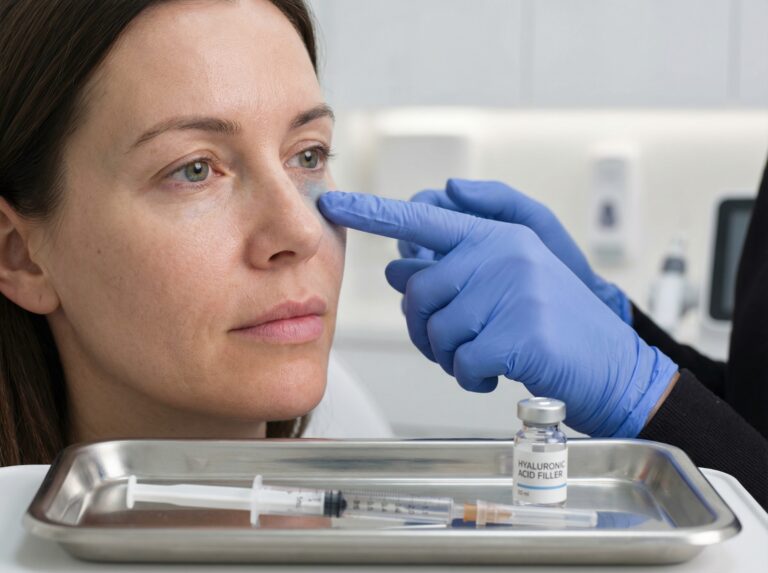
It is vital to distinguish between a droop caused by Botox and one caused by hyaluronic acid fillers. If a filler injection in the brow or temple area leads to a droopy eyelid, the cause is usually the physical weight of the product, edema (swelling), or, more seriously, vascular compromise.
Filler-related issues often require immediate intervention with an enzyme called hyaluronidase to dissolve the product. This can lead to an almost immediate correction of the eyelid position. However, Botox does not respond to hyaluronidase. Because the mechanisms are entirely different, the management strategies are also different. Botox ptosis is a waiting game of neuromuscular recovery, whereas filler ptosis might be a medical emergency requiring instant reversal. If your droop is accompanied by skin blanching, severe pain, or vision loss, it is not a standard Botox side effect and requires urgent medical evaluation.
Immediate Aftercare and Symptom Management
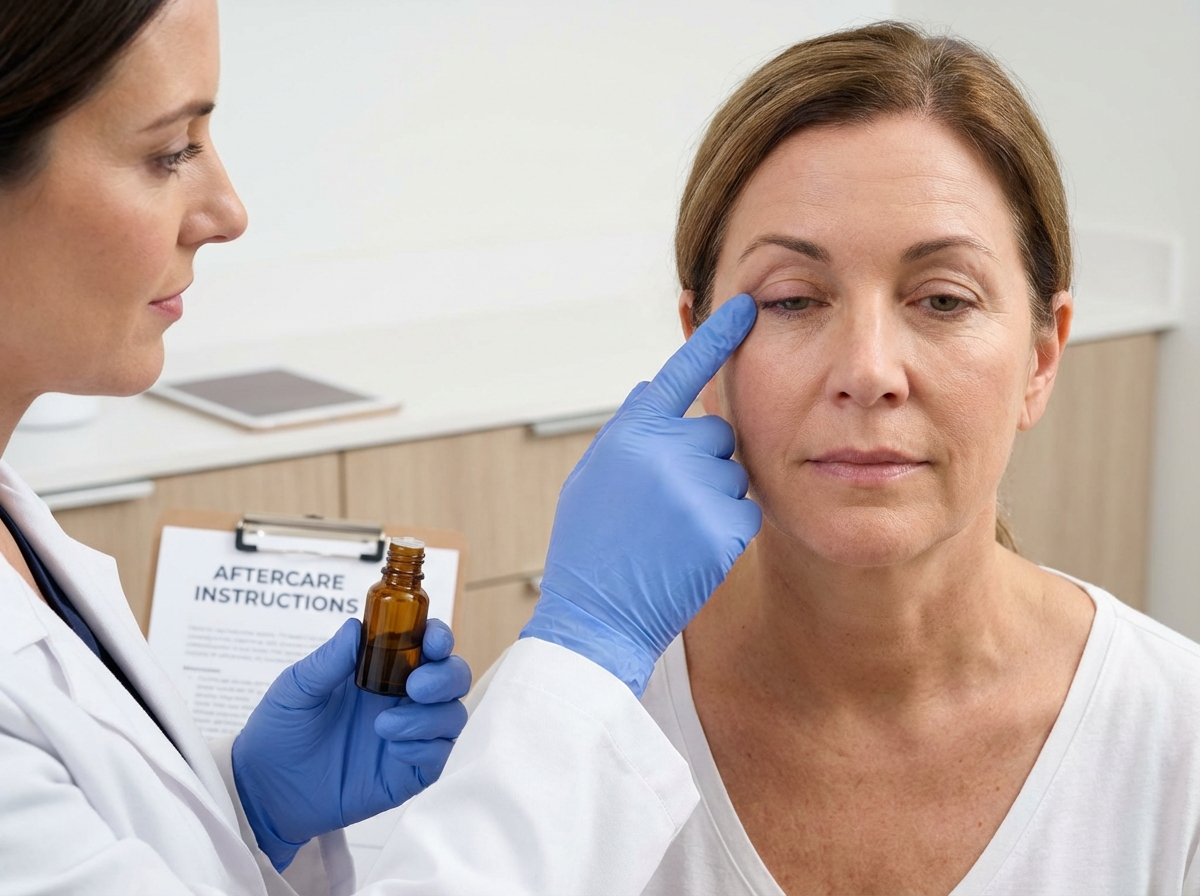
If you wake up and notice your eyelid is drooping after a Botox treatment, you should take action immediately. The first step is to contact your injector. They need to know about this complication to document it and help you manage the symptoms. You should take clear photographs of your eyes—one looking straight at the camera and another looking upward. These images serve as a baseline to track your recovery over the coming weeks.
What Not to Do
It is vital that you do not rub or massage the area. A common myth is that massaging the area will “work out” the toxin. In reality, rubbing the skin can push the toxin deeper into the muscles or spread it to adjacent areas, potentially worsening the droop. Similarly, applying heat or using vibrating facial tools has no clinical evidence to support efficacy in breaking down the toxin. The recovery process depends on your nerves regenerating new receptors, a biological process that cannot be accelerated by external physical manipulation.
Symptomatic Home Care
Home care focuses on comfort and protecting the health of your eye. If the droop is significant, you might find that your eyelid does not close completely when you blink or sleep (lagophthalmos). This puts you at risk for corneal dryness, irritation, and potential scarring.
* **Lubrication:** Use preservative-free artificial tears during the day to keep the eye moist. At night, a thick lubricating ointment is recommended to protect the cornea while you sleep.
* **Mechanical Aids:** Some patients use mechanical eyelid tape—small adhesive strips designed to lift the skin of the upper lid. While these do not fix the underlying muscle issue, they can provide a better field of vision and a more symmetrical appearance for a few hours.
* **Vision Obstruction:** If the ptosis is severe, the eyelid can cover the pupil, blocking the superior field of vision. This can make driving or reading difficult. If your vision is obstructed, it is no longer just a cosmetic issue and requires professional management.
Medical Treatments for Eyelid Lift
While there is no antidote to instantly reverse Botox, clinicians in the United States often prescribe specific eye drops to provide a temporary lift. These medications work by stimulating Müller’s muscle, a smooth muscle that contributes approximately 1 to 2 millimeters of involuntary eyelid elevation.
Apraclonidine (Iopidine)
Apraclonidine 0.5 percent ophthalmic solution is a common choice. This medication is an alpha-adrenergic agonist that causes Müller’s muscle to contract. When you use these drops, you can expect a lift of approximately 1 millimeter within minutes. The effect is helpful for functional improvement but is short-lived, usually wearing off after a few hours. Some doctors perform a phenylephrine test in the office first, applying 5 percent phenylephrine drops to see how much Müller’s muscle responds before prescribing apraclonidine.
Upneeq (Oxymetazoline)
A more recent development in ptosis management is the FDA-approved oxymetazoline 0.1 percent ophthalmic solution, sold under the brand name Upneeq. While officially approved for acquired blepharoptosis, it is frequently used off-label for Botox-induced cases. The mechanism is similar to apraclonidine, targeting alpha-adrenergic receptors. The standard dose is one drop per day in the affected eye. Most patients see a noticeable lift (1 to 2 mm) that lasts between 6 and 8 hours, providing a more consistent solution than older drops.
**Safety Note:** You must discuss your medical history with your doctor before using these drops. They are generally not recommended for people with uncontrolled high blood pressure, cardiovascular issues, or certain types of narrow-angle glaucoma.
| Treatment Option | Mechanism of Action | Expected Duration | Expected Lift |
|---|---|---|---|
| Apraclonidine 0.5% | Contracts Müller’s muscle | 2 to 4 hours | ~1 mm |
| Upneeq (Oxymetazoline) | Alpha-adrenergic agonist | 6 to 8 hours | 1 to 2 mm |
| Phenylephrine 5% | Sympathetic stimulation | 60 to 90 minutes | Diagnostic use |
Prevention and Clinical Best Practices
Preventing ptosis in future treatments starts with clear communication and precise technique. Clinical data from a large cohort of over 5,000 patients showed that with proper technique, the risk of this complication is very low. A study of these patients demonstrated that using a specific 10-minute upright protocol after injection resulted in zero cases of upper eyelid ptosis, highlighting how post-care instructions can influence outcomes.
Provider Action Checklist
Clinicians should handle ptosis cases with transparency and clinical precision to maintain patient trust:
* **Detailed Documentation:** Record the exact units used, injection points, and batch numbers. Take standardized photos for the medical record.
* **Patient Counseling:** Be honest about the timeline. Explain the mechanism of nerve regeneration and provide reassurance that the effect is not permanent.
* **Prescribing Drops:** Evaluate if the patient is a candidate for oxymetazoline or apraclonidine. Explain the dosing schedule and potential side effects like redness or irritation.
* **Injection Strategy Review:** Analyze why the diffusion happened. Consider if the injection was too low or too deep. For future sessions, stay at least one centimeter above the orbital rim and consider using lower doses in the glabellar region.
Patient Action Checklist
If you notice your eyelid is drooping, follow these steps to manage the situation effectively:
* **Contact your injector immediately:** They need to know about the complication to assess severity and provide prescriptions.
* **Document the symptoms:** Take clear photos of your eyes in natural light every few days to track recovery.
* **Protect the cornea:** If the droop is severe, use lubricating eye drops during the day and ointment at night to prevent dryness.
* **Avoid rubbing:** Do not massage the eyelid.
* **Wait for resolution:** You should wait until the ptosis has completely resolved before getting more injections, usually meaning a break of at least 12 to 16 weeks.
When to Seek Urgent Specialist Care
While most Botox-related eyelid issues are temporary and cosmetic, some situations require an urgent referral to an ophthalmologist. You should seek specialist care if you experience any changes in your vision, double vision, or severe eye pain. If the eye becomes red or feels like there is sand in it, the cornea might be drying out, which can lead to an ulcer if not treated. An ophthalmologist can provide specialized care, including prescription-strength lubricants or specialized taping techniques, to keep the eye safe while the Botox wears off.
Sources
- Management of Ptosis – PMC – NIH
- Comparative study of Botox® injection treatment for upper eyelid …
- Temporary Improvement From Unintentional Ptosis Secondary To …
- Botox and droopy Eyelids: Causes and Treatment – All About Vision
- Are Post-Care Recommendations Following Upper-Face Botulinum …
- Use of Botulinum Toxin for the Correction of Mild Ptosis | JCAD
- Treatment of Full Eyelid Ptosis Following Botox Injection: A Case …
- Understanding Eyelid Ptosis (Droopiness) After Botox
- Botulinum toxin–induced blepharoptosis: Anatomy, etiology …